
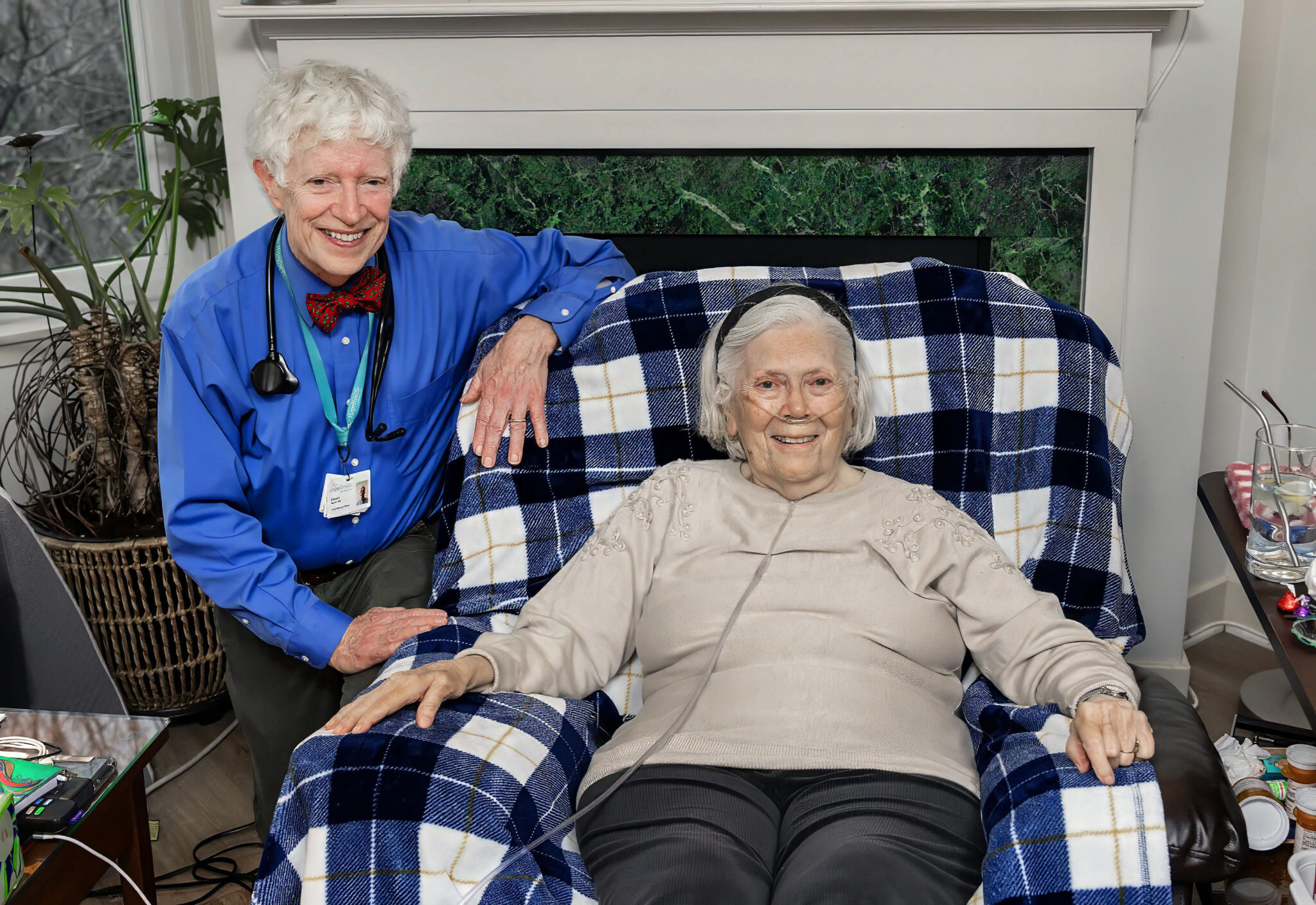
At 87 years old, Doris knows exactly what she wants.
“It doesn’t matter how long I live,” she says. “It matters how I live.”
It’s a philosophy she embodies every day — from the way she chooses how to spend her limited energy, to the way she stays deeply connected to the people, ideas and conversations that matter most to her. It’s a perspective that made her open to saying yes to hospice several months ago — and that her care continues to reflect.
Today, Doris lives at home, surrounded by books, familiar routines and a steady circle of support. She spends much of her day in her favorite recliner, reading The Atlantic, keeping up with the news, talking politics with friends, and welcoming the many people who help make it possible for her to remain where she most wants to be.
“There’s no place like home,” Doris says. “Hospice makes it possible.”
> Learn how to get started with hospice care.
A lifelong understanding of hospice
Long before she needed care herself, Doris had seen what compassionate, end-of-life support could look like. Back when she was in her 40s, she’d witnessed her mother’s final days, cared for by a trusted family physician — an old-fashioned country doctor — who focused on comfort, dignity and presence.
“I remember thinking that that was the way people should die — peacefully, supported, without unnecessary interventions,” Doris says. “In a way, I knew what hospice was, even before I knew it had that name.”
Around the same time, HopeHealth — then known as Hospice Care of Rhode Island — was just being established, making it one of the first hospice organizations in the United States. Doris’s late husband, Bruce, was one of its early volunteers. She went with him to visit the only other hospice organization at the time, in New Haven. She heard stories about the patients he visited. Many of HopeHealth’s early leaders, including founders Stanley Aronson and Charles Baldwin, were dear friends. Doris admired their work. She trusted them.
And so, when her health declined recently, she turned to the organization they helped create.
> Read: 50 years of HopeHealth: How compassionate care took root in our communities
“Everything just felt calmer”
Last year, Doris developed congestive heart failure, setting in motion months of hospital stays and time in a nursing facility. Each transition took a toll.
“Every time I went into the hospital or nursing home, I seemed to get worse,” she says. More than anything, she longed for stability — and care that felt personal.
Eventually, a hospital physician suggested hospice, and she met with a nurse to talk about what it would mean. She still had a lot of life ahead of her. But instead of continuing treatments that no longer seemed to be working — and that may have been making her feel worse — the focus would shift to comfort, quality of life and support.
Doris thought about her mother. She thought about her husband’s volunteer work. She said yes.

Support for body, mind and spirit
Since beginning hospice care with HopeHealth, Doris says the difference has been profound.
“It has just been wonderful,” she says. “Everything just felt calmer. I could finally relax. Before, I was getting worse and worse — and now, I seem to be holding my own.”
Her hospice team includes a nurse case manager, Nicole, who visits nearly every week — and more often if needed. Between visits, Doris knows 24/7 help is always just a phone call away.
“Every time Nicole comes, she says, ‘Call if anything changes. Call me if you need anything,’” Doris says. “You feel like you’re the center of the universe.”
Her hospice team also includes a chaplain, Lisa, who she speaks with every week; a social worker; CNAs; and a favorite volunteer — a Brown University student named Ryan, whose weekly visits are filled with lively conversation.
“All of these people on my HopeHealth team, they remind me that I still have purpose,” Doris says. “That I still matter.”
Hospice care has helped Doris manage the physical symptoms of advanced heart disease, including shortness of breath and chest discomfort. With medication, oxygen and expert guidance, her team responds quickly on difficult days, before symptoms become overwhelming. They also offer emotional and spiritual support.
“I’ve always been spiritual, but not religious. My chaplain, Lisa, somehow bridges that gap,” says Doris. “Talking with her has brought a real calm into my life.”
It’s also helped her live intentionally.
“When you’re looking at life and you’re saying, ‘Well, I have eight really good hours each day — it’s my choice how I choose to spend those,’” says Doris. “Hospice has helped me with that.”
> Read: What’s the difference between hospice & palliative care?
A good year
Despite the limitations of her illness, Doris describes the past year as a good one. It sometimes surprises people.
“You might think someone in my position would be depressed,” she says. “But I’m not. I’m grateful for each day.”
Doris’s hospice physician — HopeHealth’s chief medical officer, Edward Martin, MD — has seen that resilience firsthand.
“Many people assume hospice is about dying,” says Dr. Martin. “But with Doris, it’s so clearly about living. She’s found meaning, connection and joy.”
Doris knows that, like all of us, her time is limited. But she also knows how she wants to fill that time: comfort, conversation, gratitude and choice.
“I plan to keep living until I die,” she says.