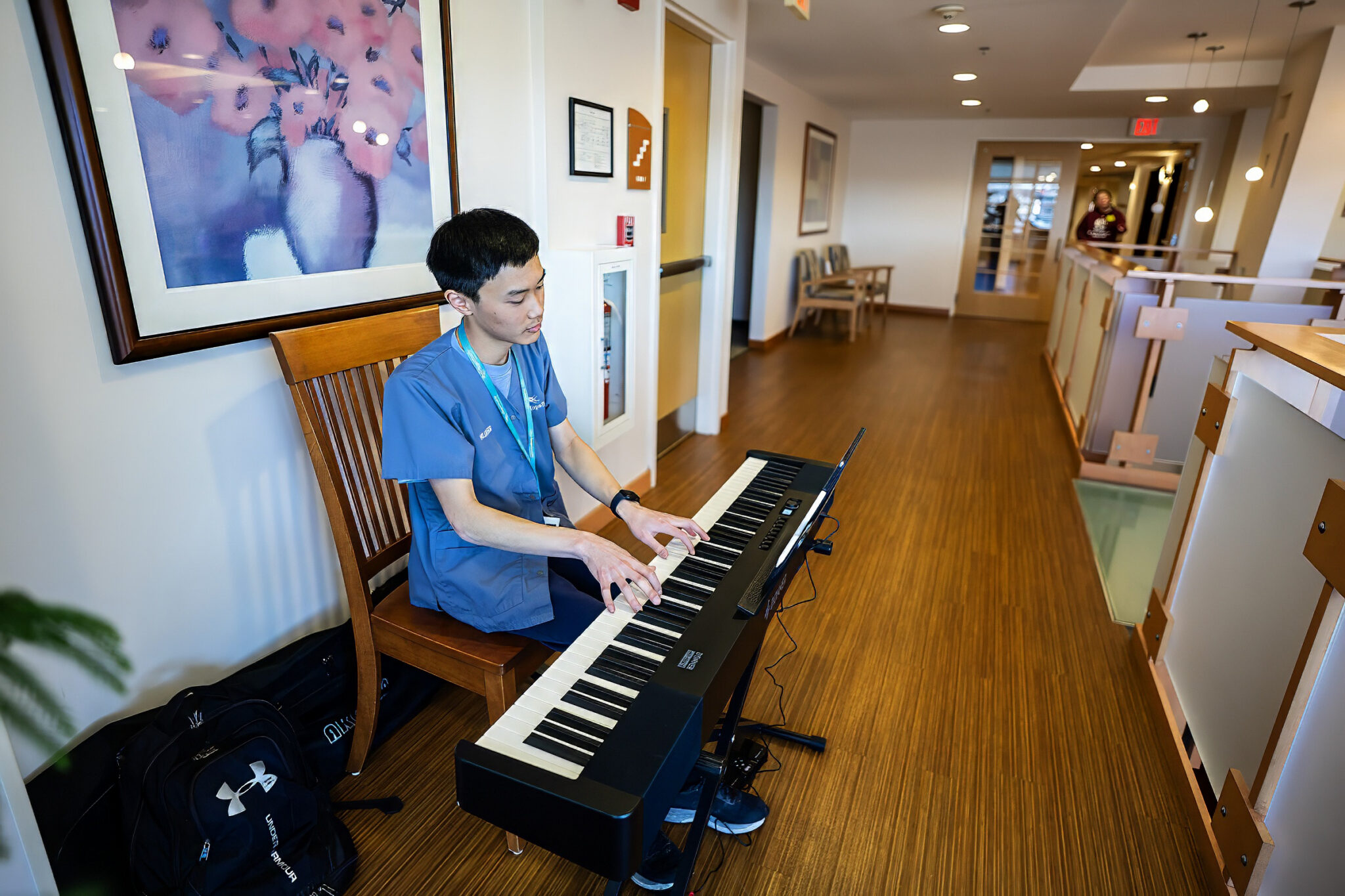
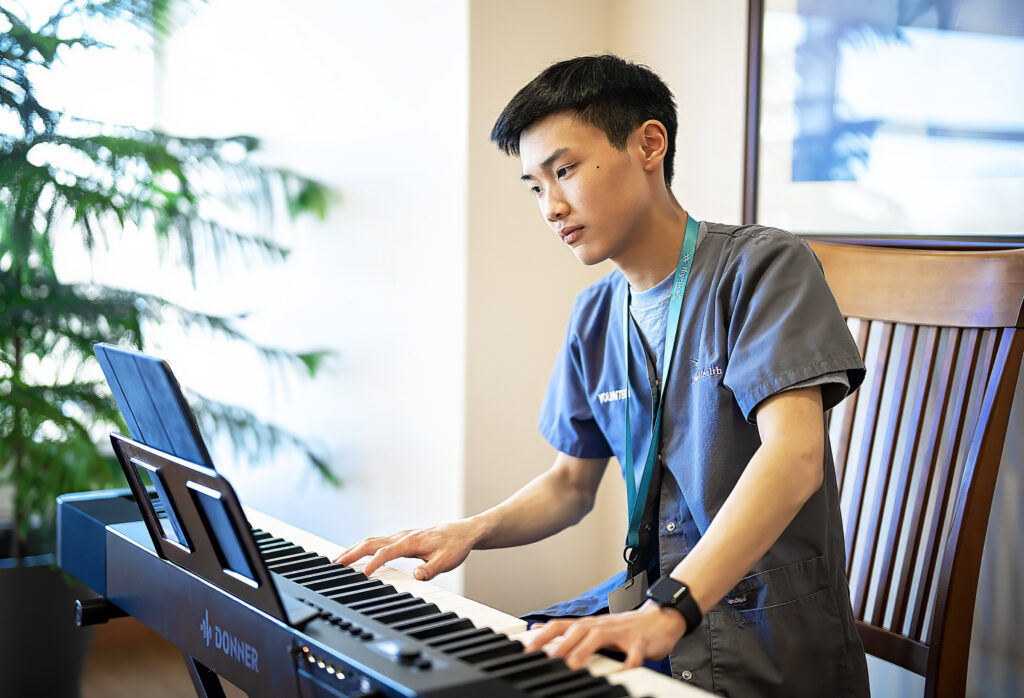
When you walk into the HopeHealth Hulitar Hospice Center most Saturday afternoons, you can follow the sound of music to find volunteer Nathan Woo, age 16. Seated at the center’s piano, he plays soothing classical music and familiar movie scores — songs he’s chosen and practiced with this place in mind.
Visitors often stop to thank him. They’ll share what a song meant to their loved one, or a moment of connection it sparked.
On a recent Saturday, a family guided an older woman, a hospice patient, from her private room into the common area by Nathan’s piano. As he played, he heard the daughter ask her mother if she was enjoying the music. He watched their heads lean together as they listened, and the smile on both their faces.
From his seat at the piano, Nathan felt it too.
“Music touches us in a different way than words do,” he says. “It can help in ways that maybe a normal conversation wouldn’t.”
> Want to make a difference? Become a HopeHealth volunteer.
Finding a way in: Nathan’s story
Across HopeHealth, volunteers offer many different gifts to patients and families — gifts of presence and service to help navigate one of the hardest passages of life. And what each volunteer brings tends to reflect who they are.
For some, including Nathan, that means music.
When Nathan reached out to HopeHealth last fall to ask about volunteering, he was thinking about his grandfather.
“I’ve seen my grandfather’s worsening dementia and memory loss. But when I play for him, the one thing that remains constant is he’ll remember songs from his childhood,” Nathan says.
At weekly family gatherings, Nathan plays classical pieces from when his grandfather was a young man, and his daughters were learning the piano. He even learned a tune the garbage trucks used to play through the streets of his grandfather’s childhood neighborhood in Taiwan. When these songs begin, his grandfather becomes fully present — humming, swaying, engaged in a way that can otherwise be hard to reach.
“It amazed me that music could spark emotion and memory that way,” Nathan said. “I really wanted to share that with others.”
> Read: “It’s like a miracle”: A volunteer helps unlock memories through music
A bright spot in the day: Roberta’s story
The impulse to help — to bring comfort, connection, a song, whatever it may be — shows up differently in every volunteer.
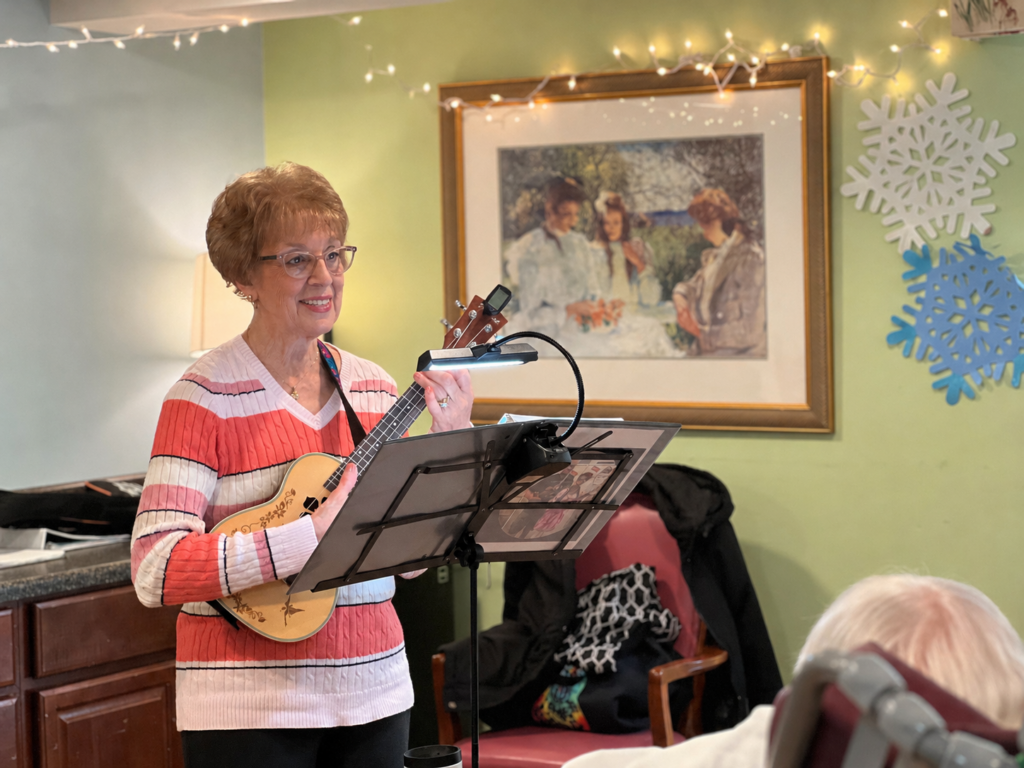
When Roberta Williams first began volunteering with HopeHealth more than a decade ago, she wasn’t thinking about music at all. At the time, her hospice visits centered mainly on conversation, readings, crafts, looking at photos together, or simply sitting together. In her private life, she was learning the ukulele — her husband’s idea, something they’d taken up together. She has many fond memories of sitting across from him at their dining room table, each practicing their craft. After he died in 2020, she continued her lessons, but never imagined playing solo.
That changed during a visit with a hospice patient. When the patient’s daughter mentioned how much her mother loved music, Roberta surprised herself by offering to bring her ukulele. From then on, music became part of their visits.
At first, the woman sang along. As her illness progressed, she listened and smiled. Even when she was no longer conscious, Roberta came and played.
“Just singing a soft song creates a connection,” she says. “It’s personal, that level of connection.”
That experience reshaped her volunteer work. These days, her ukulele is almost always with her — playing and singing to individual hospice patients, small groups, and even, once a month, to a packed room at a local nursing home.
For these crowds, Roberta’s repertoire runs heavy on the oldies — “Goodnight, Irene,” “Hey Good Lookin’,” “You Are My Sunshine.” “I’ve Been Working on the Railroad” never fails. She brings lyric sheets, invites participation, shares song trivia.
“It helps people focus on the happy times,” she says. “It’s a bright spot in what could be a quiet or lonely day.”
And it often turns into a singalong.
“Even for people who are far advanced in their dementia, music really uplifts them,” Roberta says. “It helps them recall and relive happy memories, which is so important.”
> Read: 6 Steps to Create a Healing Music Playlist for Grief
At the bedside: Grace Note Singers
If Nathan’s music opens a moment, and Roberta’s invites participation, another group of volunteers focuses on something quieter: what music can offer at the very end of life.
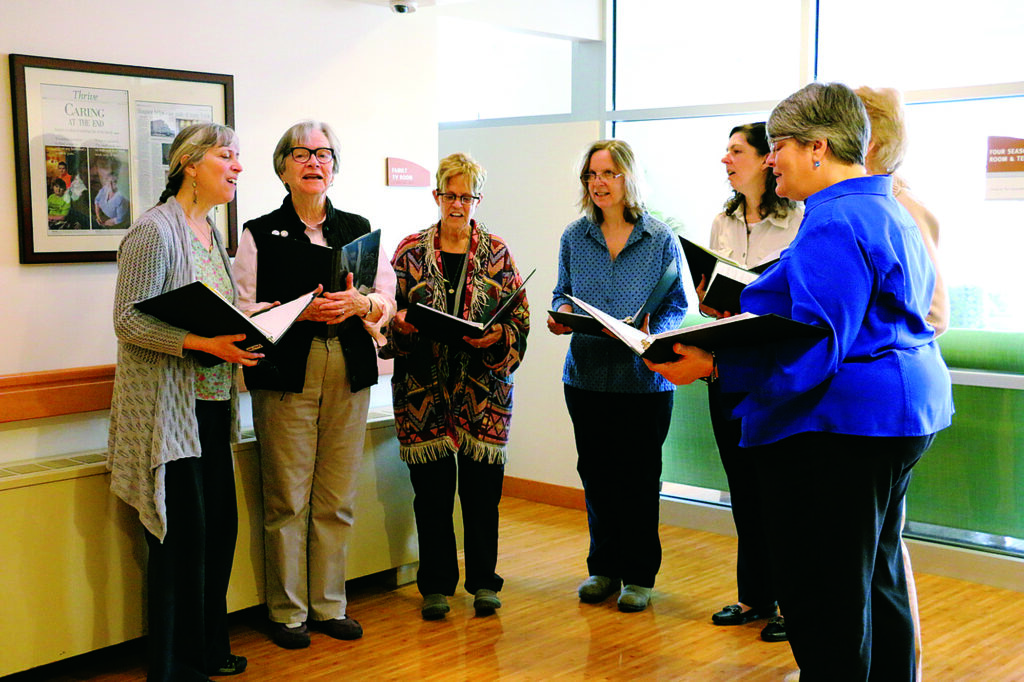
Grace Note Singers gather in small groups at bedsides — in homes, nursing facilities, and the Hulitar Hospice Center — to sing gentle harmonies for patients at the end of life, and their loved ones. Every song is filled with quiet intention, wrapping everyone in the room in a sense of reassurance.
“It really is about creating a moment of grace,” says Debbie Block, one of Grace Note Singers original members.
The group began in 2014, when founder Jodi Glass hatched the idea in her living room. It’s since grown to about 30 members, all women, who volunteer throughout the community. Each visit is unique, with songs chosen in a patient’s preferred language, from a faith tradition, or because a family member mentioned a childhood favorite.
“For the person who is in transition, sound is the last sense to go. Through music we hope to help them move with peace in that transition moment,” says member Debbie Watrous, who has been with the group a few years. “Music gets below conscious level, and heals.”
“You feel the heart opening,” agrees long-time member Deborah Langstaff. “Often family members who have been stoically sitting there will begin to cry and take the hand of the person who’s dying. Patients who have not been speaking will begin mouthing the words.”
One man had not moved for days, but as the Grace Notes sang, he slowly lifted his arms into the air and held them there while his family gathered close. A woman with dementia, a former choir director, was agitated when the group arrived — but once the singing started, she leaned back, closed her eyes, and swayed along. At a patient’s room in the Hulitar Hospice Center, in the moments after the group concluded their last song, a husband who’d been silent picked up the thread of music, and began singing his own song to his wife.
For families and loved ones, these moments are often accompanied by a profound sense of peace — hard to describe, but unmistakable.
Debbie Block has heard one phrase more than once, spoken quietly by a family member leaning close to someone who is dying:
“The angels have come. The angels have come to sing you home.”