
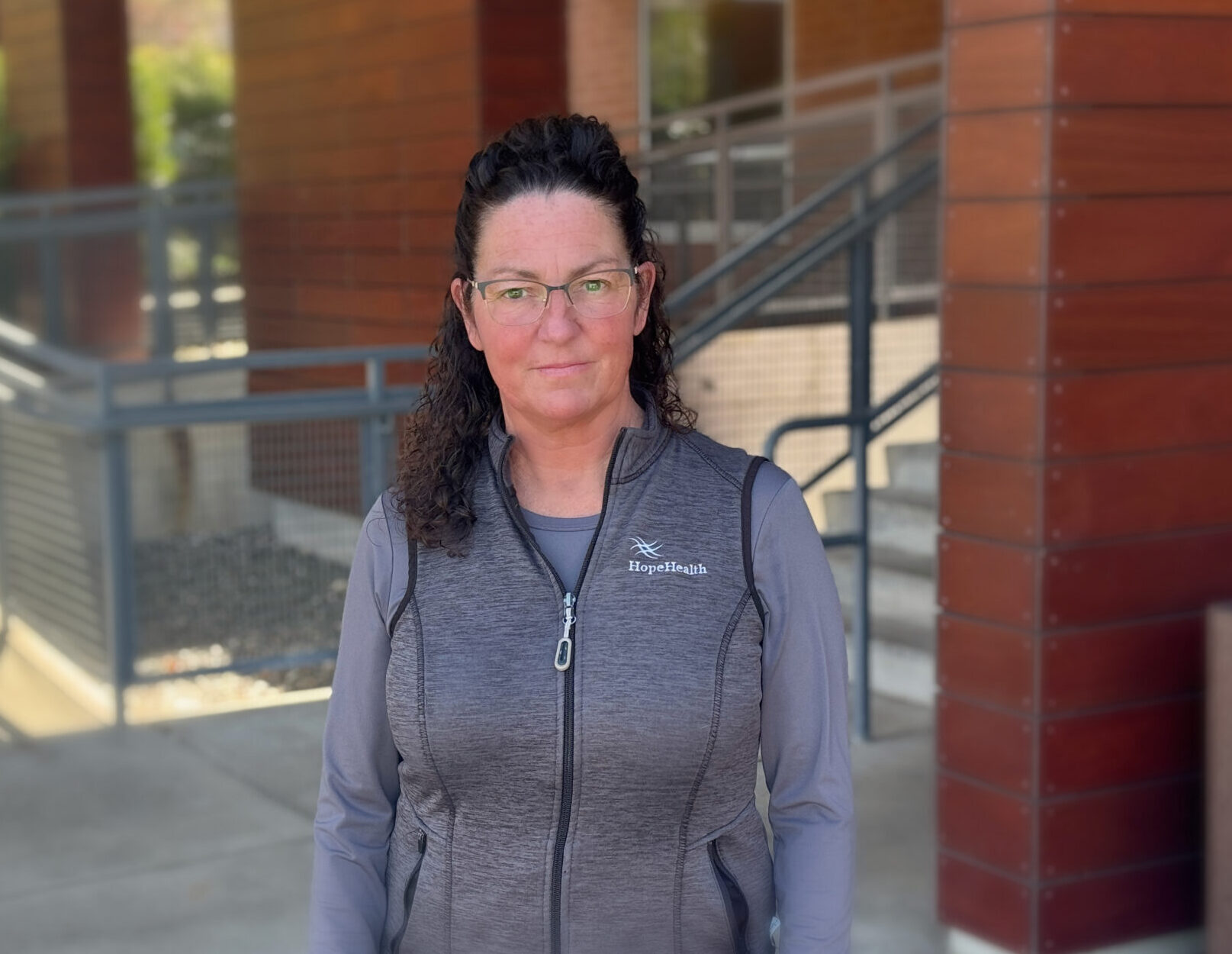
If you could choose your dream role to finish your career, what would it be? That’s the question Terese (Terri) Tetreau, RN, BSN, had to answer after an injury changed her path.
She’d already built a long career in nursing — 26 years. Most of that time was spent in critical care, at the bedside and in leadership roles. She’d seen a lot. The pace, the pressure, the responsibility of trying to save lives: These had defined her work for more than two decades.
So when it was time to come back, she paused.
“What do I want to do that will take me through the twilight of my career?” she remembers asking herself.
Her answer was hospice.
> Learn how to get started with hospice care.
Why hospice?
For Terri, hospice felt like the place her nearly three decades in nursing had been pointing her to all along.
“In the ICU, I saw what end of life could look like,” she says. “Some of it was peaceful. Some of it wasn’t. I always felt strongly about the kind of care patients and families deserved in those moments.”
And then there was her own experience.
“Both of my parents were on hospice. I saw the difference that support made – not just for them, but for our whole family,” she says.
She joined HopeHealth about two and a half years ago and started on the admissions team. It was different from what she’d experienced in her career, but she also found that she loved it.
“You go into medicine to save people. That’s always the goal. But there are times when that’s not where the patient is anymore,” she says. “Hospice is about meeting them there and asking, ‘how do we support you now?’”
> Read: Presence, choice, connection: Inside the daily work of a HopeHealth RN case manager
Being the first point of contact
As an admissions nurse, Terri is often the first person families meet.
“I’m the first face of hospice,” she says. “That first visit matters. It really sets the tone for everything that comes after.”
She doesn’t take that lightly.
“My goal is to set the team up for success. And to make sure the patient and family feel supported right from the start,” she says.
That means thinking beyond just the clinical side of care.
“We’re looking at the whole picture of a person — what they’re going through physically, but also socially, spiritually, what the family needs… It’s all connected,” she says.
It also means having conversations that aren’t easy.
“You have to be comfortable being uncomfortable in hospice,” she says. “You’re walking into people’s homes. You’re talking about end of life. But it’s a judgment-free space. You meet people where they are.”
And when it lands — when a patient or family member relaxes, even just a little — it stays with her.
“When someone says, ‘I feel comfortable now,’ that’s it,” she says. “That’s the moment you know you made a difference.”
The work she was meant to do
For Terri, this work has become the most meaningful part of her career.
“It’s still nursing,” she says. “You’re still using your skills, your critical thinking, your assessments. But it’s also about compassion, and being present, and helping people understand what’s happening.”
Because at the heart of it, hospice isn’t about giving up.
“We’re all dying,” she says. “There’s no timeline that looks the same for anyone. What we do is support people through that journey and support their families through it too.”
And if she can do that — if she can bring even a little comfort into that space — it makes a difference when it matters most.
“If I give comfort,” she says, “they get quality.”
That’s the work she chose to carry her forward.