
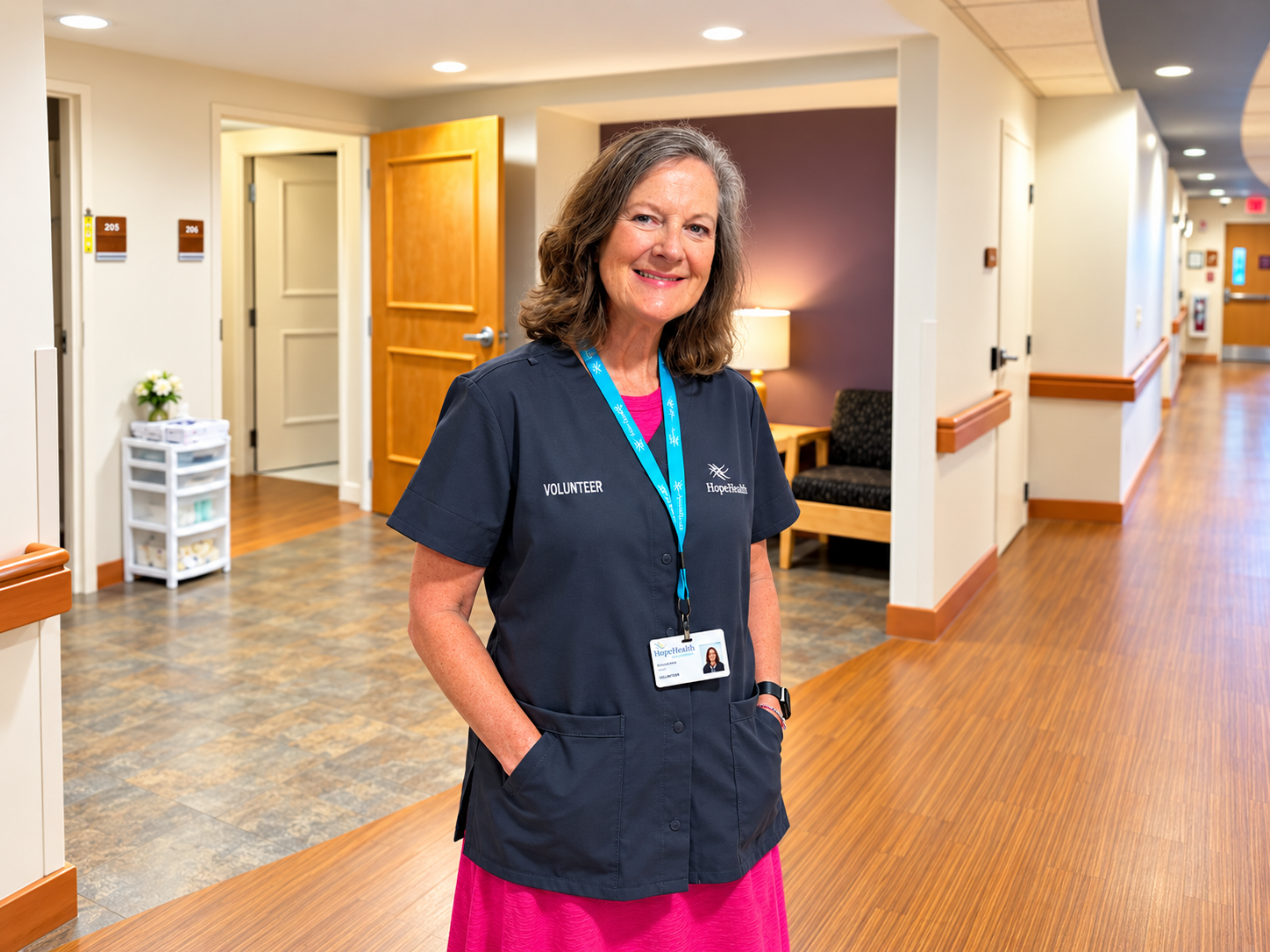
Marianne Walsh knows firsthand what companionship can mean at the end of life. HopeHealth cared for both of her parents, and when her mother received hospice care at home, a volunteer became an important part of that experience.
Now retired from a career in special education, Marianne is a HopeHealth companionship volunteer herself, visiting hospice patients at a local nursing home and, more recently, at the HopeHealth Hulitar Hospice Center.
Here, she shares what brought her to the role — and why simply being there can matter so much.
> Become a HopeHealth volunteer
HopeHealth: Your mom had her own hospice volunteer. How did that experience lead you to become one yourself?
Marianne: My mom was a RISD graduate with quite a career — a world traveler with a great appreciation for the arts. HopeHealth paired her with a companionship volunteer, Andrea, who had a similar background. It was a great match.
Andrea would come in just to chat with my mom about their shared interests. They weren’t talking about her illness, her medications or how hard things had become. That was a nice respite for my mom. With Andrea, she could talk about the things she loved and just be herself, apart from her illness. That stayed with me.
After my mom passed away and I retired, I had more flexibility, and I knew I wanted to get involved with HopeHealth myself. So here I am.
What do your visits with patients actually look like?
On the surface, it doesn’t look like a lot. You’re sitting close by. You’re giving someone your attention. You’re letting them know they’re not alone.
When I visit the nursing home, I visit about five hospice patients who are living with dementia. I might spend 15 or 20 minutes with someone, sometimes half an hour, sitting nearby or holding their hand if it feels appropriate. Most have significant communication or mobility challenges, so our time together doesn’t necessarily involve much conversation.
I play music from my phone for a few of them, and they seem to really enjoy that. I learned that one patient likes a particular Egyptian singer from about 50 years ago, and last week, she started singing along to one of the songs. That made me feel really good — that she still had that connection to the music.
More recently, I’ve also started volunteering at the Hulitar Hospice Center. It’s a very different environment. I may spend time talking with patients or family members during an intense, deeply personal time in their lives. It gives me another way to offer comfort and companionship.
> Read: The silence between notes: A hospice companion’s story
Is there a particular patient who has stayed with you?
I visited regularly with a former priest who, when we met, had moments of lucidity when we were able to talk about his background. He was funny. He used to make me chuckle.
His decline was pretty sudden. On the last day of his life, I was able to sit with him in his room. He was unconscious, but it was a meaningful afternoon — quiet and beautiful. I prayed for him with rosary beads.
I got word the next day that he’d passed away that evening. I was glad I’d been there, because otherwise he would have been alone.
What have you learned from the people you’ve spent time with?
I keep coming back to the idea that we’re all human beings on this journey together.
An illness doesn’t define who a person is. My mom knew for well over a year that she had breast cancer, and she chose not to go through treatment again — but she was still my mom. She was still a person.
That’s something I think about when I visit patients now. Someone doesn’t cease to exist as a person because they have dementia or any other illness that’s leading to their death. The illness doesn’t define them. I don’t think anyone should have to be alone at the end of life if we can avoid it.
What do you wish more people understood about hospice volunteering?
When I tell acquaintances about volunteering, I often get a wide-eyed reaction: “How can you do that?”
Many people worry they wouldn’t know what to say or do. Sometimes, they imagine hospice volunteering means being with someone in a crisis. But that’s not what it looks like. It’s really not difficult.
When I visit with patients, I’m not responsible for their medical care. I’m there to sit with them, listen if they want to talk, play some music or simply keep them company. You don’t need to say much. You don’t need to do anything extraordinary.
You’re just there, being a friend in the moment. That brings its own kind of comfort. That’s enough.