
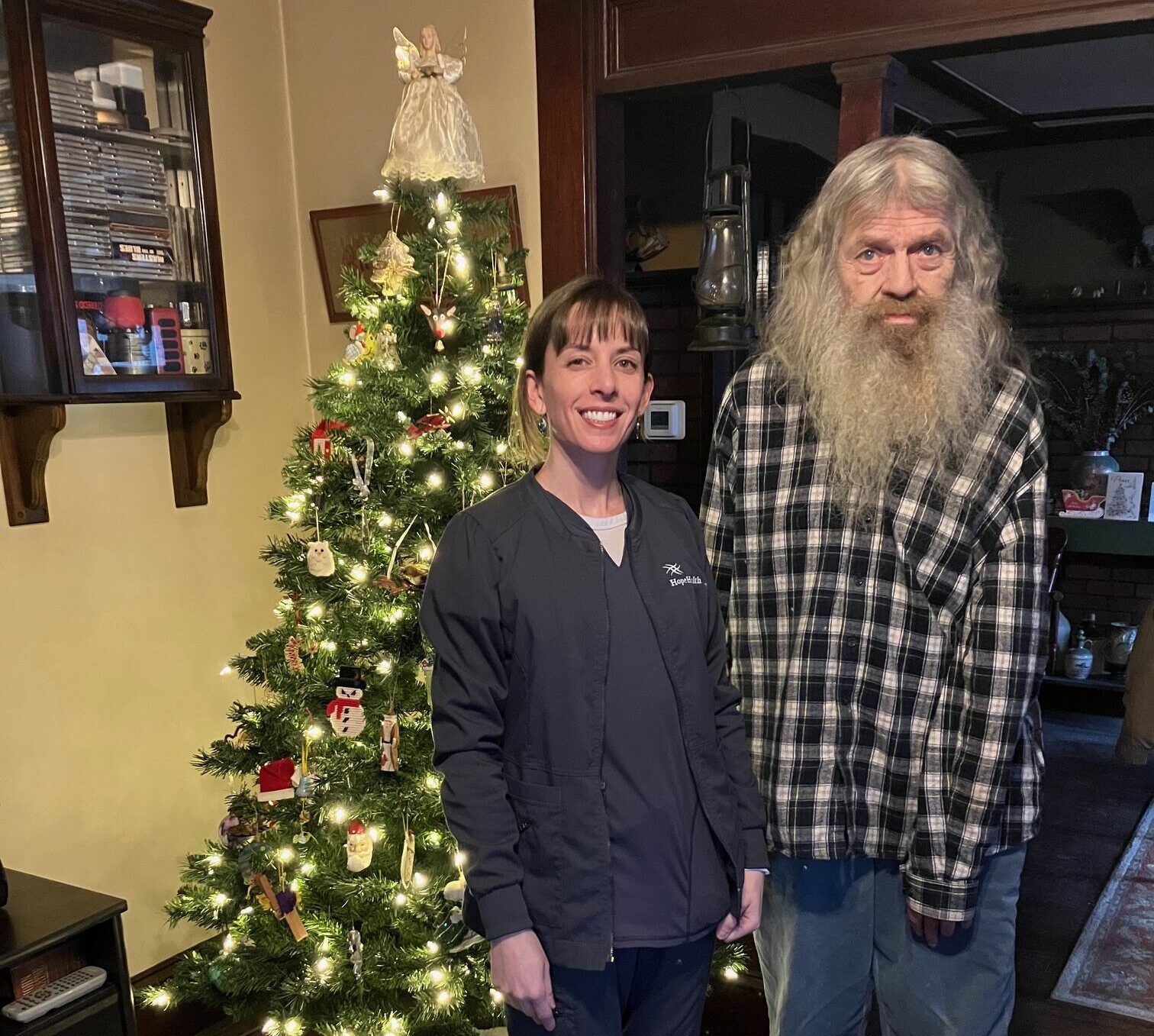
This winter, for the first time in the better part of a decade, John and Julienne Hazeldine have reliable heat in their home.
John, who receives hospice care from HopeHealth, no longer has to wake in the middle of the freezing New England night to feed the woodburning stove, working around the physical limitations of his advanced cancer diagnosis. He doesn’t have to constantly keep track of the fire throughout the day. Instead, when the temperature drops, the furnace kicks in. The thermostat holds steady at 72. He and Julienne wake each morning to a warm, comfortable home.
“I can’t take the cold like I used to. If I had to, I would’ve still done the wood stove — but this is nice,” says John, age 75. “I don’t have to worry about getting up in the middle of the night anymore. It takes it off my chest.”
That sense of reassurance — physical and emotional — reflects the kind of whole-person care hospice is designed to provide. In this story, it’s also an example of a local business that stepped forward when it mattered most.
> Learn how to get started with hospice care.
Making do — for years
Hospice care focuses on understanding who patients are, what matters most to them, and how to improve quality of life for them and their families. And so, when John began hospice care with HopeHealth, his team began paying attention not only to his medical needs, but to the everyday challenges affecting his safety, comfort and peace of mind.
John has lived many lives. He’s been a carpenter, an animal control officer, a musician, a motorcycle rider, a horse owner. He’s a lifelong New Englander whose family roots in Foxborough stretch back generations, and the home he lives in today holds that history — from antique lamps brought down from Nova Scotia to memories of relatives who once lived just across the street.
It’s also an old house, built in the 1800s and poorly insulated. When the furnace failed years ago, John tried to find someone to repair or replace it on their budget, but the process quickly became discouraging. Funding applications stalled. Answers changed. Nothing moved forward. Eventually he and Julienne decided to rely on their wood stove to heat the house, winter after winter.
John is independent, tough — “and stubborn,” he says. So at first, he took the adjustment in stride. But in recent years, the routine grew harder. He’d had multiple strokes that left his left arm weak, making it difficult to carry and load heavy logs. His shoulder was injured in a fall. And then came an advanced cancer diagnosis.
Even as he started hospice care with HopeHealth, John wasn’t complaining. When it came to heating his home, he initially told his care team the same thing he’d been telling himself for years: “I can manage on my own.”
But his team reminded him: He didn’t have to.
> Read: What’s the difference between hospice & palliative care?
Noticing what weighs on someone
John’s hospice team quickly came to understand both his needs and his nature. They saw how independent he is, and resilient. But they also saw that the furnace was becoming a safety risk, and a quiet, constant source of anxiety.
Addressing concerns like this is part of hospice’s holistic approach to care — one that looks beyond symptoms to the realities of daily life.
In addition to doctors and nurses, hospice teams include professionals who offer emotional, spiritual and even practical support — connecting patients and families with resources they may not know exist, or may be too overwhelmed to pursue on their own.
“They’re very friendly and caring. I trust them, you know,” says John.
When John mentioned the ongoing challenge of heating his home, his team began looking for a way to help. His chaplain appointed herself advocate for all things furnace-related. She began making calls: gathering estimates, asking questions, and looking for a solution that respected John’s pride and limited resources.
Eventually, she connected with BDL Heating & Cooling, a local company that agreed to assess the home and significantly reduce the cost of installation. Even when delays arose — supply costs increased, financing took longer than expected — the company stayed committed, holding their original quote and remaining steady throughout the process.
“They were very good,” John says. “Very patient.”
When the new furnace was finally installed, it brought more than physical warmth. It brought peace of mind. As John and Julienne navigate this next chapter of life with a serious illness, they don’t have to worry about staying warm. Instead, they can focus on making the most of every moment.
A community that shows up
Today, John still lights the wood stove on damp days, just to take the chill out of the air and enjoy the atmosphere, often with their cat, Cosmo, nearby. He still drives Julienne to work. He still meets his older brother for breakfast once a month at a local diner. He still greets each day with the same stubborn resilience that has carried him through decades of change.
And day after day, he proves one of the great lessons of hospice: It’s about living as well as possible for as long as possible.
Often, that happens through the power of community. In the words of John’s chaplain: “Hospice is not one person, and it’s not one solution. It’s a community responding when someone needs help.”