

Hospice and palliative care have a lot in common: Both offer extra care for serious illness, and draw on everything from medical tools to practical support to improve quality of life.
But each also has its own distinct place in a patient and family’s health journey. And knowing the difference is crucial — because it can mean getting the support you need right when you need it.
Here’s how these types of care differ, and how each can help.
1. When you qualify: The difference between hospice & palliative care
The key distinction between hospice and palliative care is the “when.”
“Palliative care and hospice both support people with serious illness,” says Jennifer Ritzau, MD, HopeHealth’s VP of Medical Staff. “But they support people at different points in the journey.”
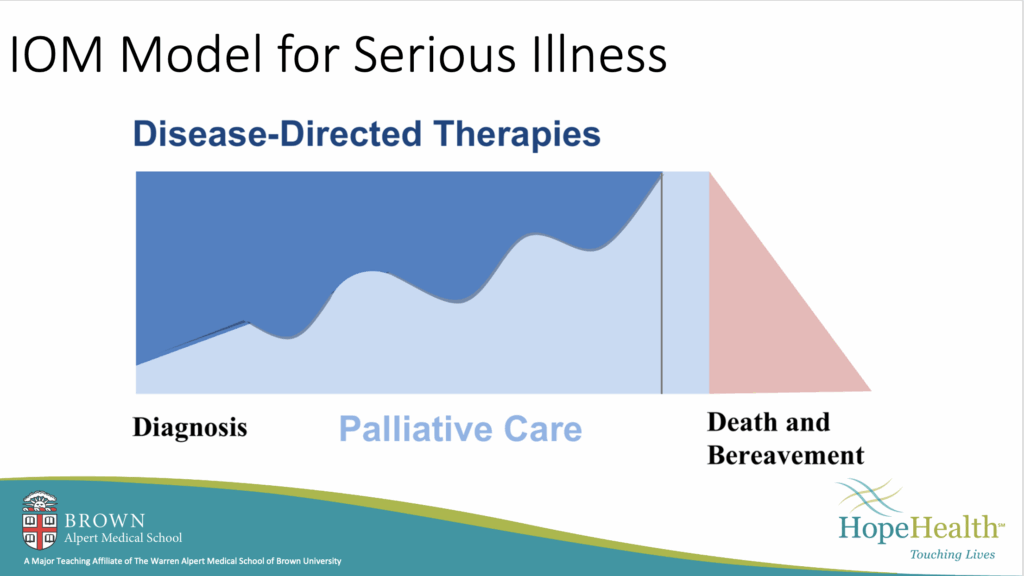
Palliative care can begin the moment you are diagnosed with a serious illness
- Palliative care can be offered to people of all ages and at all stages of a serious illness (such as cancer, heart failure, COPD, liver disease, dementia or another complex disease).
- The goal is to hep relieve the may sources of suffering that people experience when they or a loved one is seriously ill.
“Palliative care can make a huge impact, and in more ways than most people realize,” says Dr. Ritzau. “We help control symptoms, manage pain or shortness of breath, talk through what to expect as your illness and treatment change or progress, and make sure your care is aligned with what matters to you.”
Hospice can begin when treatment is no longer effective or desired, and your illness is at a very advanced stage.
- “To qualify for hospice, two physicians must certify that if the illness follows its usual course, they wouldn’t be surprised if the person died in the next six months. But that’s just the definition — it’s not a prediction,” says Dr. Ritzau. “Some people live much longer than that on hospice, even for years.”
- An important note: Many people think that hospice care is only for the last few days of life. But in fact, most people qualify for hospice when they still have weeks or months left to live.
“Having hospice services in place can make that precious time so much easier for patients and their families,” says Dr. Ritzau. “Most people tell us that they wish they had called hospice sooner.”
> Read: Does palliative care mean someone is dying?
2. If you’re considering curative-aimed treatments
Are you still eligible if you’re pursuing curative-aimed treatment?
- Palliative care: Yes
- Hospice: It depends
Pallaitive care can be delivered along with curative or aggressive interventions.
For instance: “People with palliative care might be receiving chemotherapy or radiation, going to dialysis or being hospitalized for flare-ups of your condition,” says Dr. Ritzau.
Hospice prioritizes comfort.
“Usually with hospice, life-prolonging treatments like chemotherapy, radiation or being admitted to the hospital are not part of the plan — but each patient is different,” says Dr. Ritzau. “Each patient and their hospice team will determine what treatments may be helpful, and if those interventions can be part of the plan of care.”
3. Your potential range of services
Palliative care is delivered in different settings and by very different providers — so its services can vary widely from state to state and program to program. Hospice, on the other hand, is a federal (nationwide) benefit — so hospice care looks more alike from program to program.
In both cases, services are offered as an extra layer of care, on top of your regular doctors.
“Palliative care and hospice are an addition to your existing care — not a replacement,” says Dr. Ritzau.
Palliative care services:
- Nurses, nurse practitioners, palliative care physicians, and sometimes social workers
- Continuing all existing medications and potentially adding some new medications designed to relieve symptoms
- Collaborating with your existing team to continue all necessary medical supplies and equipment
- Care can be delivered in an outpatient clinic, hospital, or sometimes at home, depending on your local palliative care program
Hospice services:
All of the above, PLUS
- 24/7 support
- A dedicated interdisciplinary team that must consist of a physician, nurses, social workers, chaplains and grief counselors
- Responsible for managing and paying for medications, and any needed medical supplies or equipment related to the advanced illness
- Hospice aides who can assist with personal care
- Often, volunteers who provide services like companionship; light housekeeping; holistic support like Reiki, pet therapy and music therapy; and more
- Care wherever the patient is, whether at home, nursing home, hospital or inpatient hospice center
- Thirteen months of free bereavement counseling for loved ones
> Read: Clearing Up Myths About End-of-Life Symptom Relief
4. How your insurance covers care
Palliative care coverage varies.
- Most insurance plans, including Medicare, pay for palliative care visits to a provider just like any other specialists, and patients may have a co-pay for services.
- Coverage can vary widely by state, setting and insurer.
Hospice is a fully covered benefit.
- Hospice is covered fully by Medicare, Medicaid and most commercial insurances (although individual benefits may vary).
- For most people who need hospice, it is covered by insurance — so it’s free to patients and families.
“Both of these services can be of tremendous benefit to patients and families walking the overwhelming and often scary world of a serious, life-threatening illness,” says Dr. Ritzau.
The difference between palliative care & hospice: Chapters of the same book
Think of palliative care as the support that walks with you and your family through the illness. Hospice is the support that carries you and your family through the final stage.
“Many people are put off by the words hospice and palliative care, as there are misconceptions that these interventions shorten life or are very focused on dying. Nothing could be farther from the truth,” says Dr. Ritzau. “Both are about helping people live as well as they can, for as long as they can. Both services will work to improve your quality of life, and allow you to spend that time in the way that you want to spend it.”
Ask about these services as soon as you may be eligible — whether that’s at the moment of diagnosis of a serious illness, or when you’re thinking about shifting to a more comfort-focused plan of care.
“Both palliative care and hospice are here to help,” says Dr. Ritzau. “You’re entitled to these services, and you shouldn’t wait to benefit from them.”
Video: Understanding the Difference Between Palliative Care and Hospice
In this video, Dr. Ritzau offers a clear explanation of how palliative care and hospice differ and how each supports patients and families.